Year 6
AUTUMN TERM

Art
Bees, Beetles and Butterflies
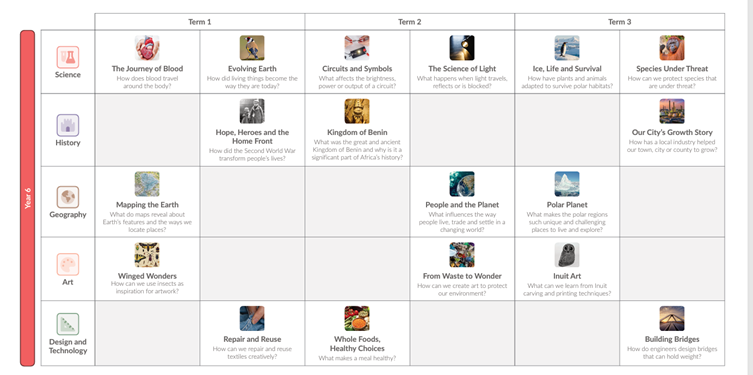
This project teaches children about sketchbooks, observational drawing, mixed media collage and Pop Art. They consolidate their learning to make a final piece of artwork inspired by bees, beetles or butterflies.

Art
Colour and Style
This project teaches children about the transport role of the human circulatory system, its main parts and primary functions. They learn about healthy lifestyle choices and the effects of harmful substances on the body.
Computing
In Autumn Term, children will understand the benefits of creating graph types digitally before moving to blogging to effectively engage an audience.
Children will learn what networks do and how they connect devices.

Design and Technology
Make, Do and Mend
This project teaches children a range of simple sewing stitches, including ways of recycling and repurposing old clothes and materials.

Geography
Our Changing World
This essential skills and knowledge project revises the features of Earth, time zones and lines of latitude and longitude to pinpoint places on a map. Children find out more about map scales, grid references, contour lines and map symbols. They learn about climate change and the importance of global trade. Children analyse data and carry out fieldwork to find out about local road safety. They study patterns of human settlements and carry out an enquiry to describe local settlement patterns.

History
Britain at War
This project teaches children about the causes, events and consequences of the First and Second World Wars, the influence of new inventions on warfare, how life in Great Britain was affected and the legacy of the wars in the post-war period.

Music
Hoes Work Songs
This project links with our class novel 'Holes'. We listen to a range of work songs and discuss the genre and musical elements using the correct terminology. Children create their own lyrics and perform these with musical instruments to the rest of the class.

PSHEe
Children explore different types of attraction and relationships. Children discuss different topical issues and the importance of respecting other points of view. Children also learn the difference between marriage and civil partnership.

Physical Education
In the Autumn Term, children will learn how to play Netball and Multiskills, focussing on how to play as a team and follow rules aswell as attacking and defending.
Children will also learn Dance and OAA where they will explore different moves and create a sequence to music.

Religious Education
In the Autumn Term, children learn about Wisdom and sacred books in particular the Bible. We also look at Interpretation and link this to the Christmas Story. We visit Shirley Baptist Church and the learn the differences between Matthew and Luke's versions.

Science
The Circulatory System
This project teaches children about the transport role of the human circulatory system, its main parts and primary functions. They learn about healthy lifestyle choices and the effects of harmful substances on the body.

Spanish
In the Autumn Term, children learn the different parts of the day and the different things they do at School in Spanish. Children do a range of speaking, listening, reading and writing activities.
SPRING TERM

Art
Environmental Artists
This project teaches children about the genre of environmental art. They study how artists create artwork that addresses social and political issues related to the natural and urban environment. Children work collaboratively to create artwork with an environmental message.

Art
Inuit
This project teaches children about the Inuit way of life, including some of their cultural and artistic traditions.

Computing
Children will use functions, flowcharts and control simulations. Children will move to Python, using block codes. Children will use standard software to perform calculations, enter formulae and enter data onto a spreadsheet.

Design and Technology
Engineer
This project teaches children about remarkable engineers and significant bridges, learning to identify features, such as beams, arches and trusses. They complete a bridge-building engineering challenge to create a bridge prototype.

Geography
Frozen Kingdom
This project teaches children about the characteristics and features of polar regions, including the North and South Poles, and includes a detailed exploration of the environmental factors that shape and influence them.

Music
Classroom Jazz
This is a six-week Unit of Work that builds on previous learning. It is supported by weekly lesson plans and assessment. All the learning is focused around two tunes and improvising:
Bacharach Anorak and Meet The Blues.

PSHEe
Children explore different stereotypes and the importance of valuing diversity. Children also evaluate media sources and the importance of staying safe online.

Physical Education
Children will play football and build on their skills from the Autumn Term before moving on to Hockey.
Children will continue to develop their skills in Dance and Gymnastics towards the end of term.

Religious Education
Children explore different rituals and find the differences between a ritual and a routine, they link this to Ramadan and Eid-ul-Fitr. Children look at suffering and how this is shown in the Easter Story.

Science
Light Theory
This project teaches children about the way that light behaves, travelling in straight lines from a source or reflector, into the eye. They explore how we see light and colours, and phenomena associated with light, including shadows, reflections and refraction.

Science
Evolution and Inheritance
This project teaches children how living things on Earth have changed over time and how fossils provide evidence for this. They learn how characteristics are passed from parents to their offspring and how variation in offspring can affect their survival, with changes (adaptations) possibly leading to the evolution of a species.
SUMMER TERM

Art
Trailblazers, Barrier Breakers
This project teaches children about significant black artists and their work, and provides opportunities to analyse and create artwork inspired by them.

Computing
Spreadsheets
Using industry standard software to work with spreadsheets. Performing calculations. Entering and using formulae. Presenting data. Solving real-life problems.

Computing
3D Modelling
Exploring computer-aided design in 3D using the 2Design and Make tool. Working with viewpoints of 3D objects. Adding and editing points on a model. Designing for a purpose.

Computing
Binary
Understanding binary as a number system and its purpose and application in computing. Examining how binary represents data in digital systems. Counting in binary. Converting from decimal to binary. Exploring binary in relation to game states.

Design and Technology
Food for Life
This project teaches children about processed food and healthy food choices. They make bread and pasta sauces and learn about the benefits of whole foods. They plan and make meals as part of a healthy daily menu, and evaluate their completed products.

History
Mafaa
This project teaches children about Africa past and present and the development of the slave trade. It also explores Britain’s role in the transatlantic slave trade, the causes and consequences of the European colonisation of Africa and the worldwide communities that make up the African diaspora.

Music
Music and Me
Music and Me introduces pupils to inspirational women in music as part of Brighter Sound’s Both Sides gender-equality initiative. The unit explores identity, beginning with gender and cultural influences, while children experiment with making their own music.
Pupils learn from four contemporary British female artists—Shiva Feshareki, Eska Mtungwazi, Afrodeutsche and Anna Meredith—whose ideas shape discussion and composition tasks.The unit shows how music can be used to explore identity, building confidence, creativity and self-expression.

Music
Reflect, Rewind and Replay
This unit brings together a wide range of high-quality music resources, including enhanced Listen & Appraise activities, progressive warm-up and flexible games, improvisation opportunities and a digital composition tool.
It consolidates pupils’ musical learning from across the year, revisiting songs and activities while introducing the history and language of music. Children develop their skills in listening, singing, playing instruments, improvising and composing, using both voices and instruments.

Physical Education
Handball
This handball unit builds pupils’ confidence, skills and teamwork through an exciting invasion game. Children learn how to catch, pass, dribble, defend and shoot using a variety of techniques, applying these skills in competitive situations.
As the unit progresses, pupils develop tactical awareness, communication and teamwork, culminating in a handball tournament where they work collaboratively, apply rules fairly and demonstrate sportsmanship. The unit supports physical development, resilience and enjoyment of physical activity.

Physical Education
Athletics
In this KS2 Athletics unit, pupils develop a wide range of running, jumping and throwing skills. Children learn to throw and push for distance, sprint with speed and control, jump effectively, pace themselves over longer distances, and work together in relay events.
The unit builds physical competence, coordination and endurance, while also promoting teamwork, resilience and a positive attitude to competition.

Physical Education
Fitness
This Year 6 Fitness unit builds on prior learning to further develop pupils’ physical skills, fitness and understanding of exercise. Children improve their ability to run, jump, balance and move with agility, strength, power and coordination, while learning how to perform exercises with good technique and control.
Alongside physical development, pupils build important personal and social skills such as resilience, perseverance, cooperation and communication. They are encouraged to reflect on their performance, give feedback and think about how to improve.
The unit also develops pupils’ fitness knowledge, introducing key vocabulary and concepts such as repetitions, sets, explosive power and different types of exercise. Children learn how regular physical activity strengthens muscles, improves heart and lung health, and supports both physical and mental wellbeing.

Physical Education
Rounders
This Year 6 Rounders unit builds on pupils’ prior learning to develop confident and effective batting, bowling, fielding and tactical play. Children refine their running, throwing, catching and striking skills, applying speed, strength, balance and coordination in competitive game situations.
Pupils learn and apply the rules of rounders, including scoring, bowling techniques and ways to get batters out, while developing decision-making and tactical awareness during play. The unit places a strong emphasis on teamwork, communication and cooperation, helping pupils build self-belief and play fairly.
Through structured games and tournament-style activities, children develop precision, tactics and sportsmanship, gaining a deeper understanding of how to play rounders effectively and enjoyably.

PSHEe
Health & Wellbeing
This unit supports pupils’ personal development, health and wellbeing, helping them understand the factors that affect mental health and how to look after it. Children learn strategies for managing change, loss and bereavement, develop healthy habits for managing time online, and build resilience as they grow in independence and prepare for key life transitions.
Pupils also learn about human reproduction and birth in an age-appropriate way, alongside important knowledge about personal safety, including keeping personal information secure, understanding rules and laws, and making informed choices. The unit addresses drug use, the law and media influences, equipping pupils with the skills and confidence to make safe, responsible decisions now and in the future.

Religious Education
Rites of Passage
This unit explores the idea of life as a journey, focusing on rites of passage and why important moments are marked in different cultures and religions. Pupils reflect on their own life experiences and consider events that have been significant in their journey so far.
Children learn how rites of passage are used within religious traditions to mark key life events, developing a secure understanding of practices such as the Muslim naming ceremony and Hajj. They are encouraged to think deeply about the meaning and value of these rituals for believers, and to consider how rites of passage can also have importance within their own lives and wider communities.

Religious Education
Salvation
This unit explores the Christian concept of salvation, supporting pupils to develop understanding, reflection and evaluation. Children learn what salvation means and how Christians express this belief through teachings, practices and ways of life.
As the unit progresses, pupils consider the importance and value of salvation for Christians, discussing questions and issues it may raise. They are encouraged to reflect on their own responses to the idea of salvation and think about how these views can be applied thoughtfully within their own lives and in the lives of others, developing respect, empathy and critical thinking.

Science
Electrical Circuits & Components
This project teaches children about electrical circuits, their components and how they function. They recognise how the voltage of cells affects the output of a circuit and record circuits using standard symbols. It also teaches children about programmable devices, sensors and monitoring. They combine their learning to design and make programmable home devices.

Spanish
Comer Sano – Healthy Lifestyles
In this unit pupils will learn the nouns and articles/determiners for 10 ‘healthy’ and 10 ‘less healthy’ foods, along with the 1st person singular conjugation of the high frequency verbs ‘to eat’ and ‘to drink’. By the end of this unit pupils will be able to say what they eat and do not eat, and drink and do not drink to stay healthy. They will also learn the language for a variety of physical activities and will be presented with a healthy recipe. Pupils will be able to create more detailed and personalised responses by the end of this unit in the foreign language.

Spanish
Hábitats - (Habitats)
By the end of this unit pupils will have the knowledge and skills to present both orally and in written form about various plants and animals that live in five very different habitats. Pupils will also learn the language necessary so they can detail the specific adaptations of each animal so it can thrive in its habitat.