
Writing
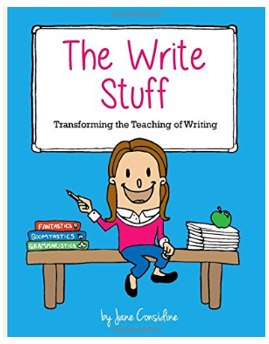
At Foundry Lane, we have adopted ‘The Write Stuff’ by Jane Considine to bring clarity to the mechanics of writing for our pupils. ‘The Write Stuff’ follows a method called ‘Sentence Stacking’ which refers to the fact that sentences are stacked together and organised to engage children with short, intensive moments of learning that they can then immediately apply to their own writing.

|
|
This approach ensures that all of our children are exposed to high quality texts that stimulate quality responses to reading, high-quality writing and purposeful speaking and listening opportunities. Our curriculum ensures that all children have a variety of opportunities to write for different purposes. We encourage writing through all curriculum areas and use quality reading texts to model examples of good writing. Writing is taught through a number of different strategies. We believe that children need lots of rich speaking and drama activities to give them the imagination and the experiences that will equip them to become good writers.
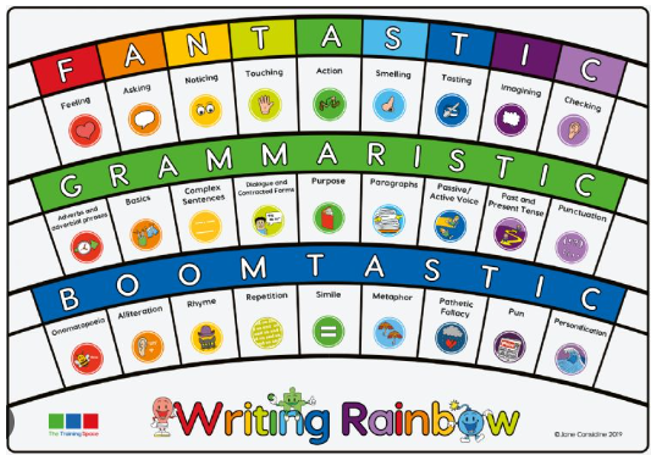
“The Write Stuff” is underpinned by ‘The Writing Rainbow’ lenses; these are put in focus each lesson and pupils carefully consider the intent of their writing whilst writing through the lenses. ‘The Writing Rainbow’ zones and lenses:
- The FANTASTICs which are an acronym that summarise the ideas of writing
- The GRAMMARISTIC is a classroom tool that enables the teacher to drive key grammar messages.
- The BOOMTASTICS which helps children capture 10 ways of adding drama and poetic devices to writing in a vivid visual
|
The Writing Rainbow contains the lenses that come into focus in our writing sessions; they are organised into three zones: the Fantastics, the Grammaristics and the Boomtastics. |
The Write Stuff
Writing learning journeys consist of experience sessions, sentence stacking lessons and independent writing. Experience session have a clear learning focus and provide creative opportunities to develop pupils’ skills, knowledge and understanding to support them in their writing. Examples of experience sessions include: paper plane making in Year 6, a visit from a dog in Year 4 and a campfire and hot milk in Year 2. Sentence stacking lessons bring lenses from ‘The Writing Rainbow’ into focus, with modelling at the heart of them, the sentence stacking lessons are broken into bite-sized chunks and taught under the structural framework of The Writing Rainbow. Teachers prepare children for writing by modelling the ideas, grammar or techniques of writing.
- Initiate section – a stimulus to capture the children’s imagination and set up a sentence.
- Model section – the teacher models a sentence that outlines clear writing features and techniques.
- Enable section – the children write their sentence, following the model.
Each learning journey concludes with pupils applying their skills in independent writing inspired by the unit completed.
Spelling
At Foundry Lane, we use the Spelling Shed programme to support children as they build their use of vocabulary. Children need to learn spelling patterns and rules, statutory words, common exceptions and personal spellings and the Spelling Shed programme allows us to do this in a little but often structure, allowing the children to revisit and review their learning, as well as learning new strategies to apply in their writing. We chose this scheme, as it gives 100% coverage of the National Curriculum for Spelling and ensure that we actively teach the children how to spell rather than test them.
Phonics provides a foundation for effective spelling, which can be applied alongside other strategies such as focusing on morphemes. By analysing the types of spelling errors pupils make it is possible to provide support specific to their needs. The report goes on to identify the most common spelling errors as being phonological, orthographical or morphological.
What is included in a Spelling Shed lesson?
Each lesson has a main objective from the National Curriculum appendix for spelling. This may be split across multiple bullet points.
At our school, each class has a stand alone spelling lesson of at least 30 minutes a week. The Spelling Shed scheme is flexible to fit our timetables and is closely linked to Read, Write, Inc phonics strategies.
Each lesson includes:
- a set of words is provided, these words are examples of the spelling patterns
- has main teaching inputs, which can then be followed up with additional activities that can be carried out immediately after the input during an extended session or revisited throughout the week in order to consolidate the learning further.
- contains a revision section which should last approximately 5 minutes. Children will revisit sounds and spelling patterns from earlier weeks in the scheme.
- has elements of the key areas below embedded in its core.
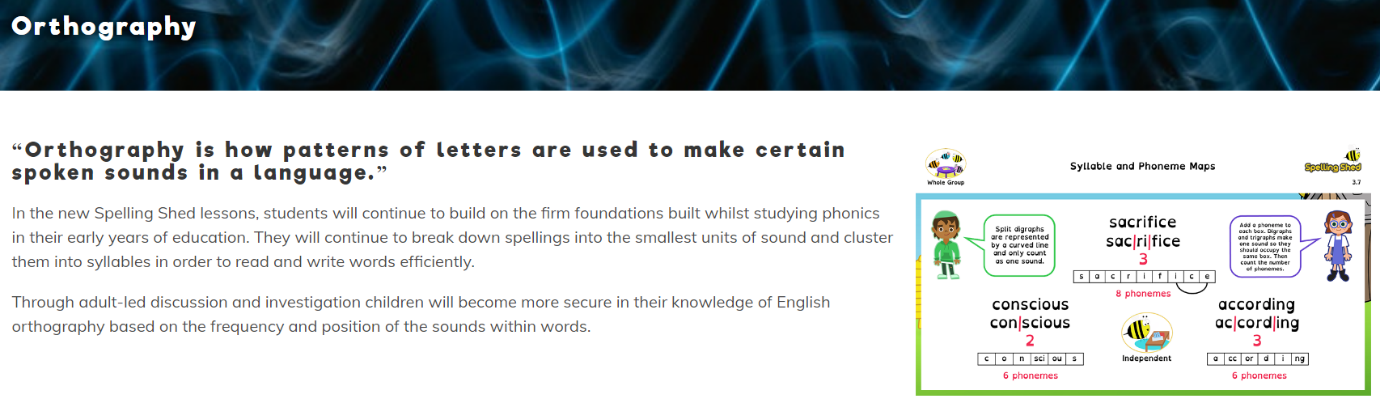
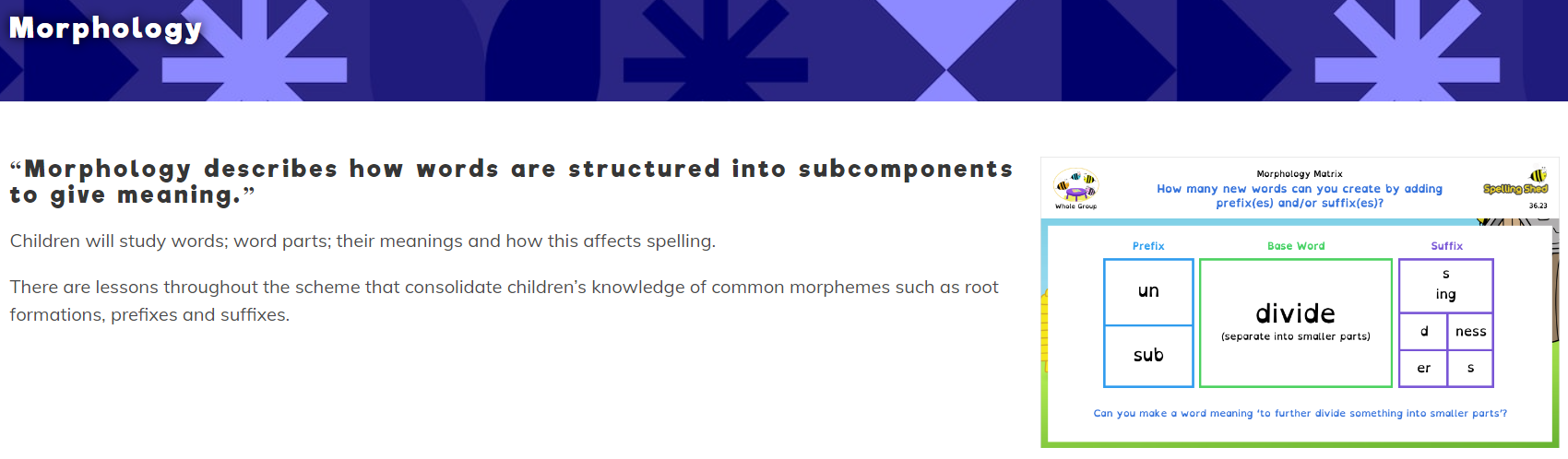
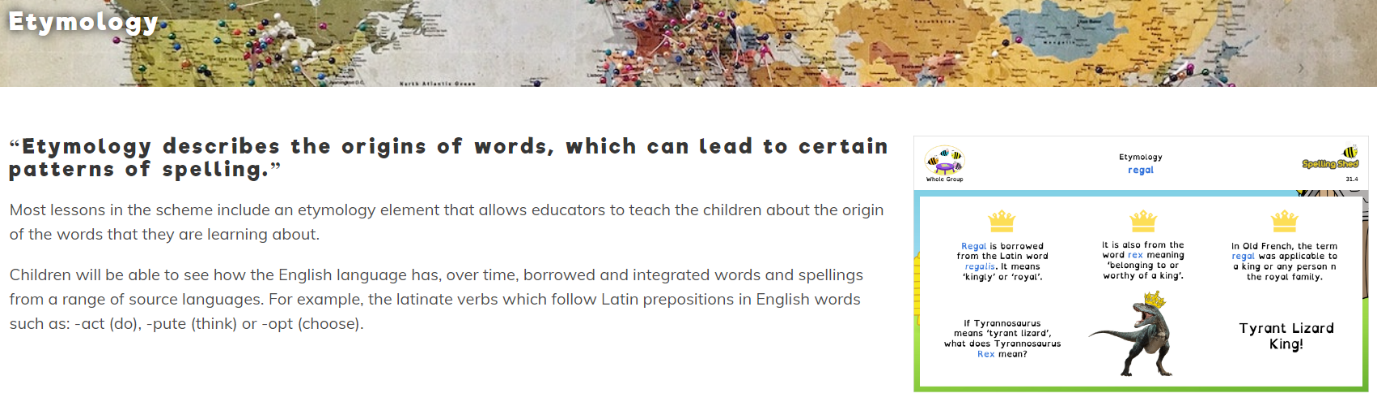
You can view the Medium Term Plan here: https://www.spellingshed.com/en-us/resource/spelling-shed-mtp-en-gb
Handwriting
At Foundry Lane, we have adopted Kinetic letters as our handwriting program. The program has four main threads:
- Making body stronger;
- Holding a pencil;
- Learning the letters, and
- Flow and fluency.
It enables children to develop legible handwriting that is produced quickly and automatically. With the development of automaticity, handwriting becomes a valuable tool and not a hindrance to learning.
Strength: writing is a fine finger operation; children must have core body and arm strength to be able to control their fingers precisely.
Pencil hold: the pencil grip must be comfortable to allow writing for long periods. Pencils with a triangular cross-section, assist in developing a correct hold.
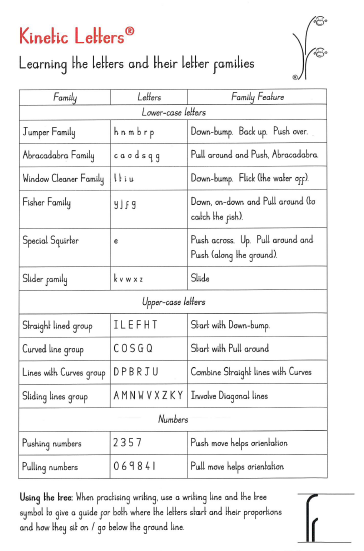
Letter formation: the movements to form the letter begin with whole body movements and progress through writing in sand trays to writing on whiteboard and finally writing on paper. In kinetic letters, all the letters and numbers are formed by one or two monkeys, a brave one (bounce) who goes to the top branch of the tree and a scared one (skip) who goes to the lower branch.
Flow and fluency: letter movement and minimised to help a fast writing style to develop. There are no lead in strokes.
In Year R daily handwriting sessions teach children to print kinetic letters using the stories about Bounce and Skip the monkey to ensure letters start and finish at the correct place.
In Year 1 weekly handwriting sessions build on letter formation, size and orientation.
In Year 2 weekly handwriting sessions focus on pupils learning to ‘snuggle’ the letters before then learning to join.
In Years 3 and 4, discrete handwriting sessions are taught weekly, and there is the expectation that kinetic letters is used in all writing across the curriculum. Moving to Years 5 and 6 where focus on a developing a more cursive style is established.
|
The Kinetic Letters families – pupils learn the grouped letters (family of letters) through stories about brave and scared monkey. |
SPAG
Year 1 and Year 2
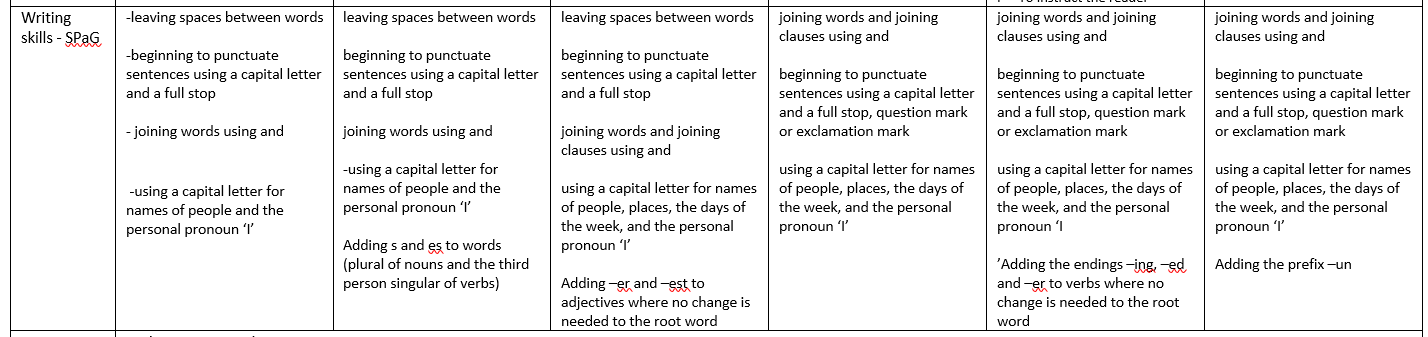
Discreet SPAG lessons are taught at the beginning of each 'The Write Stuff' unit, linking the key lenses from the units to the SPAG objectives in the National Curriculum.
Year 1
Year 2
Years 3 - 6
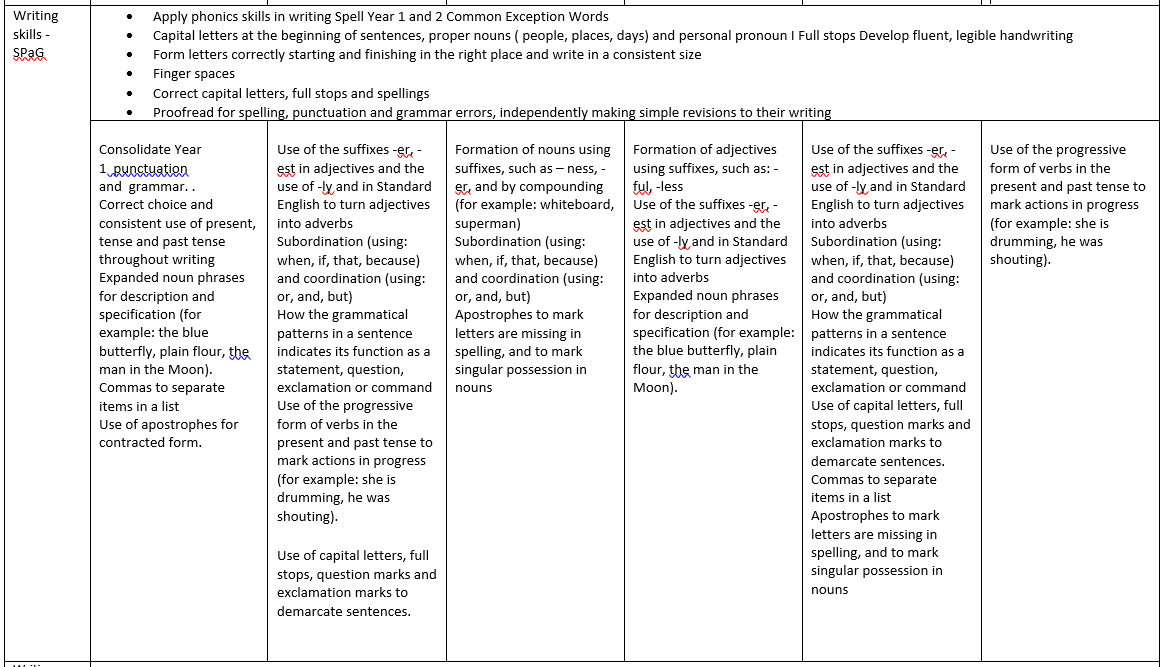
Weekly SPAG sessions are taught using the Natural Curriculum. Half-termly overviews are made using gap analysis of termly Cornerstones SPAG test results.