English
Spoken Language and Vocabulary
At Foundry Lane, we develop pupils' spoken language following the principles of the National Curriculum, which recognises spoken language as vital to development across the whole curriculum: cognitively, socially and linguistically. It underpins reading and writing, and the quality of language pupils hear and speak shapes their vocabulary, grammar and comprehension.
Teachers nurture pupils' confidence and competence in spoken language and listening, so children can express their ideas clearly and explain their understanding of texts before writing. Discussion is used to address misconceptions and clarify thinking, and pupils are taught to take turns and participate constructively in conversations and debates. Questioning is central to our teaching, encouraging children to be inquisitive and share their thoughts confidently.
Spoken language is taught at an age-appropriate level, with regular opportunities to revisit and practise skills, building deep understanding and mastery. This develops pupils' ability to communicate effectively across different contexts and audiences.
We place particular emphasis on vocabulary, aiming for every child to develop a broad and rich range of words. Subject-specific vocabulary is embedded through teacher modelling and contextual learning, while shared reading sessions allow pupils to explore unfamiliar vocabulary. We model correct grammar throughout and expect the same of pupils in their spoken and written work.
Destination Reader
Destination Reader is our approach to teaching reading comprehension after children have completed RWI Phonics. It involves daily sessions incorporating whole-class modelling, before children apply these skills through partner work and independent reading. Children deepen their understanding of the texts they read through the systematic use of a series of strategies and language stems.
The approach encompasses the key principles of effective reading provision and fully meets the requirements of the National Curriculum by building deep understanding of texts, developing oracy around reading, and increasing breadth of reading. Destination Reader also helps build a culture of reading for pleasure and purpose.
Destination Reader gives children access to real books of high quality that are engaging and exciting. Talk is central to the approach: partner reading continues throughout, and children are given many opportunities to discuss books with their partners or groups. Children are taught to use sentence stems to support them in actively listening, participating, and discussing and explaining their ideas.
Destination Reader covers seven key skills identified within the National Curriculum to support the reading and understanding of a wide range of texts:
- - Predicting
- - Making connections
- - Asking questions
- - Evaluating
- - Inferring
- - Summarising
- - Clarifying
Children are encouraged to use these skills while reading with their partner or in groups. Each week, children focus on one key strategy, deepening their understanding of both the skill and the text. From the Summer Term of Year 5, children begin to combine strategies, applying a range of skills to a single piece of text. Written comprehension is also a regular focus, with teachers modelling how to unpick a question and answer it, before children practise these skills themselves.
Reading for Pleasure
At Foundry Lane, we celebrate reading throughout every phase of the school, alongside a book-led curriculum across all phases. Throughout the school year, the importance of reading is further enhanced through:
- - World Book Day
- - Author visits
- - Book Fairs
- - Quality age-related texts
- - Destination Reader
- - Daily time for reading
Each week, we dedicate time to reading for pleasure in our classrooms, where pupils can choose the books, newspapers, or project books they wish to read and enjoy, whether independently, with a peer or adult, or as a whole class.
Every day, pupils also end the school day by sharing a story together, with adults reading a class book aloud to further build a love of reading into everyday school life.
Writing
Writing is usually planned around a book or a wider project, giving children the opportunity to deepen and apply their subject knowledge, with multiple opportunities to practise and master their skills.
Year groups identify opportunities to apply writing across foundation subjects throughout the year, considering possible genres and content coverage, and follow the school's long-term plan to ensure clear progression of skills across a range of contexts.
There's more to writing than picking up a pen or pencil. We support the pre-requisite skills for writing by developing oracy, and gross and fine motor skills.
Writing begins with an engaging hook or immersion into the project, which might be a book, image, film clip, drama, current event, or curriculum link. Where a text is used as the stimulus, this also creates an enhanced opportunity to focus on the reading-for-pleasure element of the curriculum. Each term, year groups take one book and choose a variety of outcomes to produce, with links made to the wider curriculum where appropriate.
Links are also made to reading, drama, and grammar, punctuation, and spelling, as well as other curriculum areas.
Audience and Purpose
This is central to all writing, and children are taught to identify it in both their reading and their writing. Children learn that their language and composition must meet the needs of the intended audience. There are four main purposes:
- - To entertain
- - To persuade
- - To inform
- - To discuss
Children have the opportunity to write a range of fiction, non-fiction, and poetry across the year.
Handwriting
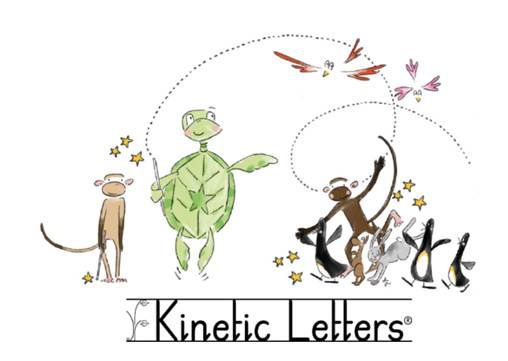
We follow the Kinetic Letters handwriting programme, an evidence-informed approach that builds the cognitive and physical skills needed for handwriting.
Kinetic Letters is a unique handwriting programme built on the belief that good, fast, and fluent handwriting underpins success in every curriculum area. It is based on a physical programme where children learn handwriting and letter formation through movement and multisensory experiences, developing core body strength along the way.
Learning letters through movement supports both writing and concentration, and helps make handwriting automatic, freeing up space in children's working memory for other learning.
The Kinetic Letters programme is built around four main threads:
- - Making bodies stronger
- - Learning the letters
- - Holding the pencil
- - Flow and fluency
Together, these help children develop legible handwriting that is produced quickly and automatically. As handwriting becomes automatic, it becomes a valuable tool for learning, rather than a hindrance to it.
Each letter family is introduced to children through a story about two monkeys, Bounce and Skip. Bounce is a brave monkey who helps write the tall letters, while Skip is a more cautious monkey who helps write the other letters. Children are taught all of the Kinetic Letters families, alongside upper-case letter formation and number formation.

