
Behaviour & Relational Practice
At Foundry Lane Primary School, we believe that positive relationships are the foundation of a successful school. Children learn best when they feel safe, valued, understood, and connected to the adults around them. Our relational approach underpins everything we do, creating a calm, consistent, and inclusive environment where every child can thrive.
Our practice is rooted in the understanding that behaviour is a form of communication. We seek to understand the reasons behind a child's behaviour, supporting them to develop the emotional regulation, resilience, and social skills they need to be successful learners and positive members of our school community. Our approach is relational and restorative, not punitive, and focuses on teaching, modelling, and reinforcing positive behaviour while providing appropriate support and clear boundaries.
A Consistent Whole-School Approach
All staff have received specialist training from our Educational Psychologist, ensuring a shared understanding of relational practice and the importance of responding to behaviour in a calm, consistent, and compassionate way.
Our dedicated Behaviour Manager works closely with staff, children, and families to ensure that support is timely, personalised, and effective. By identifying barriers early and working collaboratively with class teachers, leaders, and external professionals, we help children develop the strategies they need to succeed.
Every adult in school has a responsibility for building positive relationships with children, creating an environment where pupils feel a genuine sense of belonging.
Starting the Day Well
Every school day at Foundry Lane begins with a personal welcome. Staff greet each child individually at the door, by name, giving every pupil a positive, calm start to their day and a moment of connection before learning begins. This small but important routine helps children feel noticed, valued, and ready to settle, and gives staff an early opportunity to notice how a child is feeling that morning, as well as teaching about consent.

Our Golden Rules
Our three Golden Rules, Be Safe, Be Respectful, Be Your Best, are displayed in every classroom and explicitly taught throughout the year.

Rather than simply telling children what these rules mean, each class works together at the start of the year to co-create their own class charter, deciding as a group what Be Safe, Be Respectful, and Be Your Best actually look like in their classroom. This gives children a genuine say in shaping their own expectations, builds a real sense of ownership, and helps every child understand, in their own words, what it means to live our values day to day.
Children are taught that behaviour involves choices, and that every choice has a consequence. We use consistent, positive language to help children understand this, encouraging them to stay on the "green route," meeting our expectations and living our Golden Rules, and supporting them to return to it calmly and quickly if things go off track.
Bringing Our Golden Rules to Life
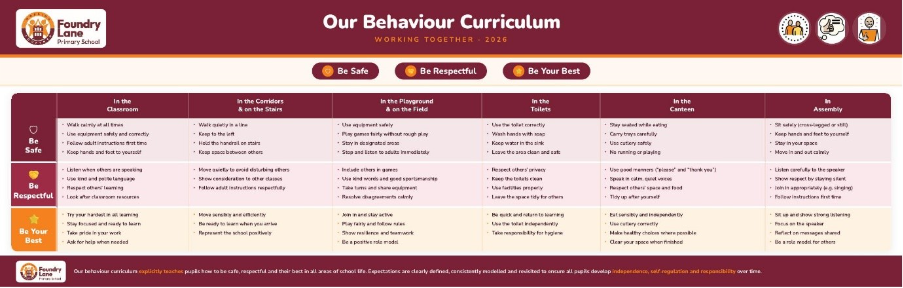
Our behaviour curriculum (co-created with the children) explicitly teaches pupils what Be Safe, Be Respectful, and Be Your Best look like in every part of school life, in the classroom, corridors, playground, toilets, canteen, and assembly. Expectations are clearly defined, consistently modelled by staff, and revisited regularly so that all pupils develop independence, self-regulation, and responsibility over time.
For example, being respectful in the canteen means using good manners and speaking in calm, quiet voices, while being your best in the playground means playing fairly, showing resilience, and being a positive role model for others. By teaching these expectations explicitly and consistently across every context, children build a clear, shared understanding of what our values look like in practice, wherever they are in school.
Promoting Positive Behaviour
Positive behaviour is actively encouraged and celebrated through:
-
- Verbal and non-verbal praise
-
- Specific feedback linked to our Golden Rules
-
- Celebration in assemblies and classrooms
-
- Regular communication with parents and carers
-
- Whole-class reward systems, including Class Dojo
Restorative Conversations
When difficulties arise, our focus is on repairing relationships rather than simply applying consequences.
Children are supported to:
-
- Reflect on their choices
-
- Understand the impact of their actions on others
-
- Take responsibility for their behaviour
-
- Rebuild relationships
-
- Develop strategies for making positive choices in the future
This restorative approach helps children develop empathy, accountability, and the confidence to resolve conflict respectfully. Where a consequence is needed, it is always proportionate, clearly linked to the behaviour, explained calmly, and focused on repair and learning, never used as a first response when a child is upset or overwhelmed.
Supporting Every Child
We recognise that some children require additional support to regulate their emotions or overcome barriers to learning. Through our wider Thrive Provision, pastoral support, and targeted interventions, we ensure children receive the help they need while remaining fully included in school life wherever possible.
All children are encouraged to identify their "High-5" trusted adults in school, five people they know they can turn to with any worry or concern. Our relational approach sits alongside our attachment-aware practice and reflects our commitment to understanding each child's individual needs.
Working in Partnership with Families
Strong relationships with families are central to our approach. We believe that children achieve the best outcomes when home and school work together with openness, honesty, and mutual respect.
Parents and carers are kept informed of both concerns and successes, involved early wherever additional support is needed, and treated with respect and openness at all times. We maintain regular communication with families through Arbor, phone calls, letters, and face-to-face meetings, and where a child is receiving additional behaviour support, parents receive regular updates on their progress.
By maintaining this ongoing communication and working collaboratively with parents and carers, we create consistent support for children both in school and at home.
Linked to Our School Values
Relational practice is not a standalone initiative: it is woven throughout every aspect of school life and underpins our behaviour culture.
Our Golden Rules, Be Safe, Be Respectful, Be Your Best, provide the foundation for the way we speak to one another, resolve difficulties, and celebrate success. Children are supported to understand that everyone makes mistakes and that, with the right support, everyone can learn, grow, and make positive choices.
Building a Culture of Belonging
At Foundry Lane, we believe that every child deserves to feel known, valued, and understood. By investing in positive relationships, maintaining high expectations, and responding with consistency and compassion, we create a culture where children feel safe to take risks, develop confidence, and achieve their full potential.
Through our relational approach, we are not simply managing behaviour: we are developing resilient, respectful, and emotionally literate young people who are ready to succeed both in school and beyond.

