PSHE
Purpose of Study
The PSHE Association organises PSHE into three core themes:
-
Health and Wellbeing: physical and mental health, healthy lifestyles, safety, risk, drugs/alcohol, puberty, first aid and personal wellbeing.
-
Relationships: families, friendships, respectful relationships, boundaries, consent, bullying, safe/unsafe relationships and relationships online.
-
Living in the Wider World: belonging and communities, responsibilities, economic wellbeing, money, aspirations, careers and digital/media literacy.
Aims
In curriculum-language terms, PSHE should enable pupils to:
-
develop the knowledge, skills and attributes they need to manage their lives now and in the future;
-
develop healthy, positive and respectful relationships with others;
-
understand how to keep themselves and others safe, including online;
-
make informed decisions about their physical health and mental wellbeing;
-
recognise risk, unsafe situations and unhealthy relationships and know how and where to seek help;
-
develop self-respect, resilience, confidence, self-regulation and positive character attributes;
-
understand and respect different families, people, backgrounds, beliefs and circumstances;
-
participate positively in their school, community and wider society;
-
develop their understanding of money, economic wellbeing, aspirations and the world of work;
-
be prepared for the opportunities, responsibilities and experiences of later life.
The DfE is particularly explicit that primary Relationships Education should establish the fundamental building blocks of positive relationships: kindness, consideration, respect, honesty, boundaries and privacy, while Health Education aims to give children the information they need to make good decisions about their health and wellbeing.
Our Approach
At Foundry Lane, we use the PSHE Association Programme of Study as the foundation for our PSHE curriculum, with learning carefully sequenced from Year 1 to Year 6 so that pupils revisit and deepen their understanding over time.
We also draw on the stories of inspirational people who exemplify the qualities and values at the heart of PSHE, such as resilience, kindness, self-respect and positive contribution to their community. By learning about people who have overcome challenges or made a difference to others, pupils see these qualities reflected in real lives and are encouraged to embody them in their own.
The sections below set out our intent for PSHE at Foundry Lane, how this is implemented in practice, and the impact we expect our curriculum to have on pupils by the time they leave us.
Intent
At Foundry Lane Primary School, we recognise PSHE as an essential part of preparing children for life, both now and in the future. Our PSHE curriculum aims to equip pupils with the knowledge, skills, language and strategies they need to keep themselves safe and healthy, develop positive relationships, make informed choices and participate confidently in the wider world.
Our curriculum is underpinned by the PSHE Association Programme of Study and incorporates the statutory requirements for Relationships and Health Education. It extends beyond the statutory content to provide a broad PSHE entitlement, including personal safety, economic wellbeing, careers education and digital and media literacy.
Learning is organised around the key areas of Health and Wellbeing, Relationships and Living in the Wider World. The importance of these areas is reflected within the PSHE Association guidance, which identifies physical and mental health, personal safety, family life, positive friendships, conflict, bullying, consent and respect as fundamental elements of primary PSHE education.
Our curriculum is deliberately progressive. Important concepts are revisited throughout Key Stages 1 and 2 with increasing depth and sophistication as pupils mature. For example, early learning about recognising feelings and friendships develops into learning about self-regulation, mental health, respectful relationships, stereotypes, boundaries and consent. Similarly, learning about keeping safe progresses from identifying hazards in the home to assessing risk, understanding influences, staying safe online and making increasingly independent and informed decisions.
Through PSHE, we want pupils to develop the confidence and resilience to manage challenges, recognise when they need help and know how to access it. Ultimately, our intention is for children to leave Foundry Lane with the foundations they need to be safe, be respectful and be their best as they move into secondary education and the wider world.
Implementation
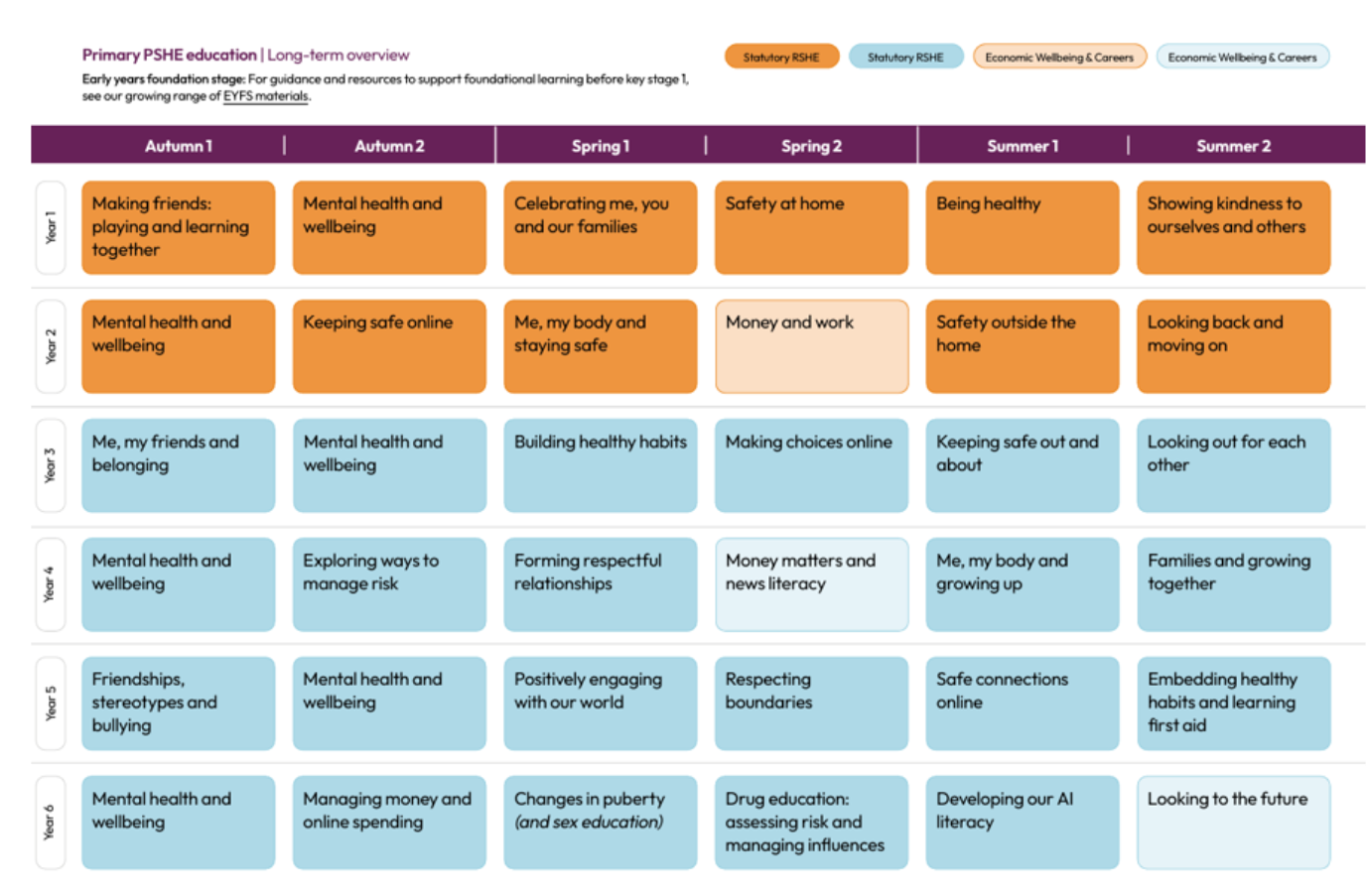
We use the PSHE Association primary curriculum and planning model to provide the structure and progression for PSHE from Year 1 to Year 6. Our long-term overview sequences learning across each year group and ensures pupils encounter a broad and balanced range of PSHE content. The curriculum includes recurring themes such as mental health and wellbeing, healthy habits, friendships and relationships, personal safety, online safety, economic wellbeing, careers and preparation for change.
Each year group follows a series of planned units which build upon prior learning. Teachers make links to previous learning so that knowledge, vocabulary and strategies are revisited, strengthened and applied in increasingly complex contexts. For example, Year 2 builds upon earlier work on feelings by introducing the intensity of emotions, strategies for managing them, and experiences of change and loss. By Year 6, pupils are applying increasingly sophisticated strategies to regulate emotions, manage distraction, develop positive thinking habits, manage worry and stress and prepare for transition to secondary school.
The PSHE Association framework identifies the intended learning and progression, while teachers draw upon high-quality, age-appropriate resources to support delivery. These include PSHE Association materials alongside carefully selected resources from organisations such as the NSPCC, CEOP, St John Ambulance, the Office for Health Improvement and Disparities, the Careers and Enterprise Company and other specialist organisations. For example, pupils encounter NSPCC Talk PANTS, online-safety materials, first-aid education, careers learning and resources supporting healthy lifestyles and wellbeing at appropriate points within the curriculum.
PSHE is taught in a way that encourages pupils to talk, think, question, reflect and apply their learning. A safe and respectful classroom climate enables pupils to discuss sensitive issues appropriately, develop relevant vocabulary, explore different perspectives and rehearse strategies that they may need in real-life situations.
Learning is responsive to pupils' age and stage of development. Content relating to growing up, puberty, relationships, consent, drugs, online safety and risk is sequenced carefully so that pupils develop secure foundations before encountering increasingly complex concepts. For example, learning progresses from understanding growing and private body parts in Year 2 to puberty in Year 4 and more detailed learning about puberty, healthy relationships and sex education in Year 6.
Where appropriate, PSHE learning is reinforced through the wider life of the school so that pupils have opportunities to apply the attitudes, behaviours and strategies taught within lessons.
Impact
The impact of our PSHE curriculum is seen in pupils who increasingly demonstrate the knowledge, confidence and skills to navigate their lives safely, healthily and responsibly.
As pupils progress through Foundry Lane, we expect them to become increasingly able to:
-
recognise, name and manage a range of emotions and use appropriate strategies to support their mental wellbeing;
-
develop and maintain positive, respectful relationships and recognise behaviours which are unsafe, unhealthy or unkind;
-
understand personal boundaries, consent and how to seek help when something does not feel right;
-
identify and assess risks and make informed decisions about their own safety, both offline and online;
-
make informed choices about their physical health and understand the importance of healthy habits;
-
understand and respect differences between people, families and communities;
-
engage critically and responsibly with digital media, online content, news and emerging technology;
-
develop an age-appropriate understanding of money, work, careers and economic wellbeing;
-
respond positively to change and transition, and know when and where to seek support.
The curriculum deliberately develops independence: PSHE education should not teach children that all risk can be avoided, but should help them understand risk and make informed, educated decisions.
Teachers use pupils' responses, discussion, questioning, reflection and application of learning to identify what pupils understand and where misconceptions or gaps remain. Over time, pupils should be able to draw upon previous learning, use increasingly precise vocabulary and explain not only what they should do in a particular situation, but why and how.
By the end of Year 6, our aim is for pupils to leave Foundry Lane with a strong foundation for the next stage of their education: able to recognise risk, seek help, maintain positive relationships, look after their physical and mental wellbeing and approach the opportunities, responsibilities and challenges of adolescence with growing confidence and independence.
Threshold Concepts
Self and wellbeing: understanding emotions, self-regulation, resilience and mental wellbeing.
Relationships: understanding what makes relationships healthy, respectful and safe.
Safety and risk: recognising, assessing and responding to risk, including knowing when and how to seek help.
Choice and responsibility: understanding that choices have consequences and becoming increasingly able to make informed, independent decisions.
Health and the changing body: understanding healthy habits, physical health, growing, puberty and looking after the body.
Identity, equality and respect: understanding difference, stereotypes, inclusion, boundaries, consent and respect for others.
Digital life: understanding how to participate safely, critically and responsibly online.
Citizenship and the wider world: understanding money, work, community, rights, responsibilities and positive participation.
Change and transition: developing strategies to manage change, loss, growing independence and transition.
Progression on a Page
Our PSHE curriculum is organised around the PSHE Association areas of Health and Wellbeing, Relationships and Living in the Wider World. Across these areas, pupils revisit key threshold concepts with increasing depth, maturity and independence.
EYFS
Self and wellbeing
Recognise and name basic feelings. Begin to identify what helps us feel calm, happy and safe.
Relationships
Develop friendships, share, take turns and recognise kind and unkind behaviour.
Safety and risk
Recognise familiar dangers and know to tell a trusted adult.
Choice and responsibility
Understand simple rules and consequences. Begin to make choices about own behaviour.
Health and the changing body
Understand basic healthy routines and that bodies grow and change.
Identity, equality and respect
Digital life
Citizenship and the wider world
Change and transition
KS1
Self and wellbeing
Recognise a wider range of emotions and begin to use strategies to manage them. Understand that feelings can change.
Relationships
Understand what makes a good friendship. Recognise respectful and disrespectful behaviour and begin to resolve disagreements.
Safety and risk
Identify hazards and risks in familiar settings. Know how and where to seek help.
Choice and responsibility
Recognise that choices affect ourselves and other people. Take increasing responsibility for actions.
Health and the changing body
Understand healthy habits, hygiene and ways to look after the body.
Identity, equality and respect
Digital life
Citizenship and the wider world
Change and transition
Lower KS2
Self and wellbeing
Develop self-regulation, resilience and strategies for managing setbacks, worries and strong emotions.
Relationships
Explore trust, conflict, peer influence and healthy and unhealthy friendships. Understand personal boundaries.
Safety and risk
Assess risks in a wider range of situations and make increasingly responsible choices.
Choice and responsibility
Consider consequences and make reasoned choices in different situations.
Health and the changing body
Explore physical and emotional health, body changes and the foundations of puberty education.
Identity, equality and respect
Digital life
Citizenship and the wider world
Change and transition
Upper KS2
Self and wellbeing
Understand mental wellbeing, stress and emotional regulation. Select appropriate strategies independently and know when to seek support.
Relationships
Evaluate healthy and unhealthy relationships, recognise coercive or controlling behaviour and understand consent, respect and responsibility.
Safety and risk
Evaluate risk, influence and consequences. Make informed, increasingly independent decisions and know how to protect themselves and others.
Choice and responsibility
Make informed and responsible decisions, considering consequences, competing influences and the impact on others.
Health and the changing body
Understand puberty, adolescence, healthy lifestyles and how physical and emotional health are connected.
Identity, equality and respect
Digital life
Citizenship and the wider world
Change and transition
The Progression Journey
EYFS: Recognise → Name → Tell → Begin to manage
KS1: Understand → Practise → Make safe choices → Seek help
Lower KS2: Explain → Assess → Apply strategies → Take responsibility
Upper KS2: Evaluate → Decide independently → Challenge unsafe behaviour → Protect self and others
By the end of Year 6, pupils should be increasingly able to explain not only what they should do, but why and how, drawing on previously learned knowledge, vocabulary and strategies.
Units of Learning